


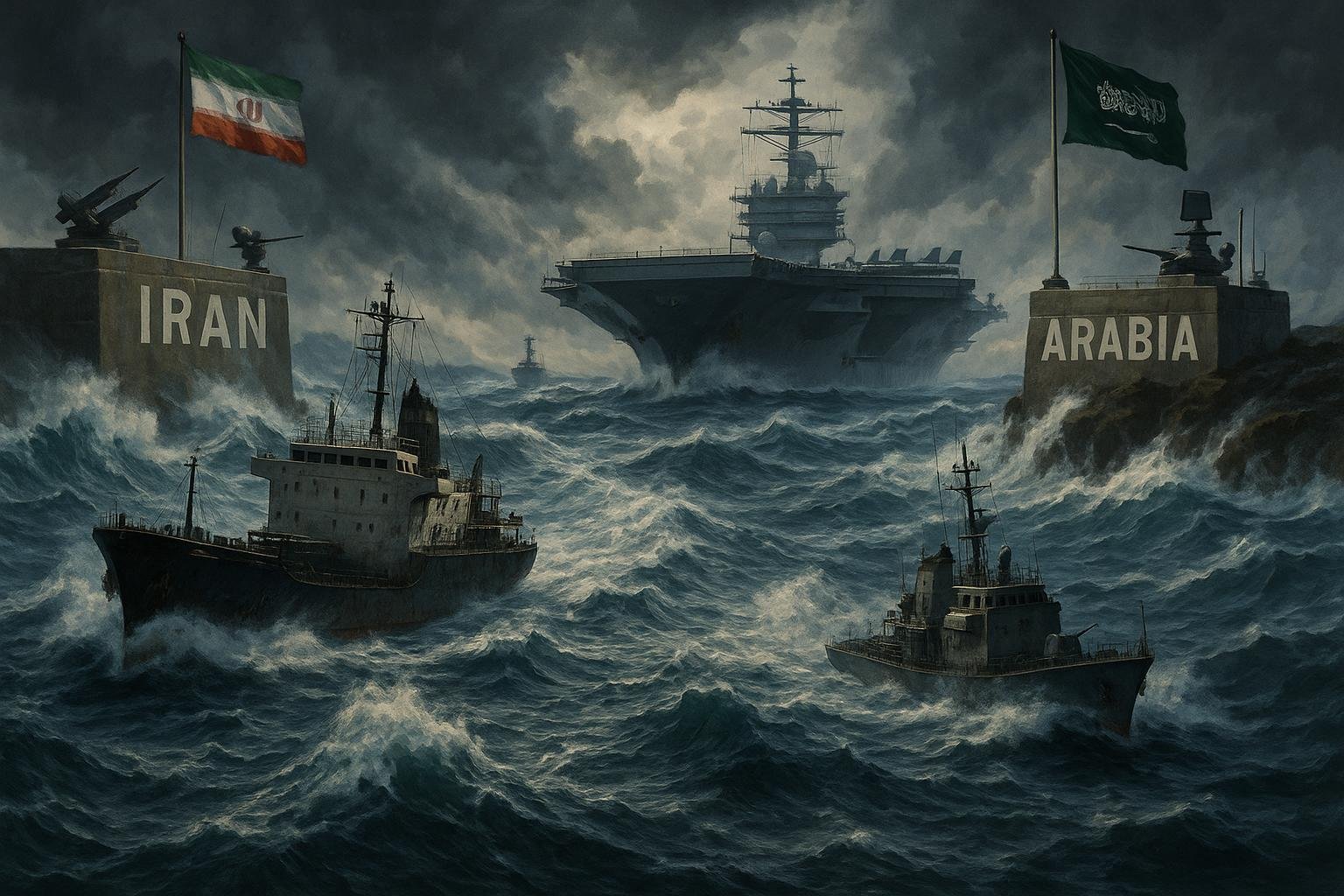
Prolonged conflicts in key maritime chokepoints, notably the Red Sea and Strait of Hormuz, have rewritten the rules of global trade, forcing industries and fintech firms to adapt to a new era of persistent geopolitical risk and supply chain fragility.

The fragile geometry of global trade has been rewritten by a convergence of maritime threats and state-on-state confrontation that, through early March 2026, has imposed a new pricing regime on commodities and forced finte...
Continue Reading This Article
Enjoy this article as well as all of our content, including reports, news, tips and more.
By registering or signing into your SRM Today account, you agree to SRM Today's Terms of Use and consent to the processing of your personal information as described in our Privacy Policy.
According to bobsguide, a “dual-chokepoint” shock , the prolonged disruption of the Red Sea trade corridor combined with a near-closure of the Strait of Hormuz , has shifted geopolitical risk from an episodic factor into a persistent pricing input for markets and the technology that serves them. The rapid escalation that began with renewed Red Sea attacks in late 2023 and broadened into a region-wide crisis by 2024 accelerated again after the strikes and counter‑strikes surrounding 28 February 2026, producing immediate and wide-ranging effects on energy, food, fertiliser and shipping costs.
Maritime rerouting and lengthened voyages have become structural. World Bank data show that by October 2024 voyages that formerly used the Red Sea had increased distances by roughly 48% for cargo ships and 38% for tankers, with travel times rising by up to 45% for cargo and 28% for tankers. Those longer journeys and the diversion of vessels around the Cape of Good Hope have created a tighter seaborne logistics picture and higher freight costs, the World Bank reported, and have contributed to a substantial accumulation of delayed container capacity in Eastern Mediterranean and Arabian Gulf ports.
Economic research and industry analysis quantify the pass-through. J.P. Morgan Research estimated the repositioning of trade and the spike in freight could add materially to goods inflation, projecting as much as a 0.7 percentage point uplift to global core goods inflation during the acute phase of disruption. The IMF documented severe falls in canal traffic in early 2024 , Suez Canal volumes halved year-on-year in the first two months of that year , and warned of longer transit times that have strained inventories and disrupted just‑in‑time manufacturing.
The energy market has been particularly volatile. Reporting compiled by bobsguide places the effective disruption of Strait of Hormuz oil and LNG flows at about 20% of global trade as of 4 March 2026, a development that coincided with sharp oil and gas price moves. Independent chronologies of the wider 2026 Hormuz crisis indicate that targeted strikes and retaliation around 28 February led to missile and drone exchanges and a marked withdrawal of commercial transit, pushing Brent well above levels seen in prior weeks and, in some accounts, beyond the $100 per barrel threshold in early March. European wholesale gas prices have also surged amid reports of attacks on LNG infrastructure, creating acute margin and liquidity pressures for energy‑intensive industries and the financial platforms that support them.
Commodity markets beyond hydrocarbons have felt the ripple effects. Fertiliser supplies were weakened where shipments transited the Gulf lanes, with immediate knock‑on risks for crop inputs and food production. Agricultural oils and other energy‑sensitive commodities have moved higher as freight and feedstock costs rise. Gold and other safe‑haven assets have attracted flows as investor uncertainty intensified.
This environment has pushed fintech and trading‑system architects to embed conflict dynamics into pricing and risk tools. Bobsguide notes a rapid adoption of real‑time geopolitical indicators: satellite AIS tracking to monitor vessel rerouting, automated “heat maps” of contested sea lanes and integrations of insurer notices into margin systems. There is heightened interest in tokenised real‑world assets as market participants explore faster, more transparent settlement mechanisms when traditional maritime insurance and correspondent banking frictions widen. At the same time, exchanges and platform operators are hardening cloud and API defences as cyber risks and the potential for state‑linked disruption grow.
Governments have responded by elevating strategic resource programmes. According to reporting summarised here, the United States has announced a major stockpiling effort for critical minerals and other strategic inputs, while the UK has tightened measures aimed at curbing sanction‑busting shipping practices. Those moves signal a policy pivot: access to certain commodities is being treated as an element of national resilience rather than a purely commercial concern.
Not all figures align on magnitude and timing. The World Bank and IMF emphasise the cumulative, measurable increase in voyage distances, delays and shipping costs through 2024, while industry trackers place the initial shipping diversion and insurance shocks in late 2023 and through 2024. Wikipedia entries summarise the escalation around 28 February 2026 as a further intensification that produced expanded missile and drone exchanges and prompted near‑cessation of traffic through Hormuz. Taken together, the accounts outline a trajectory from episodic attacks to an interconnected, multi‑year disruption that now feeds directly into market pricing and fintech risk frameworks.
For market participants the implication is clear: the baseline for commodity and logistics risk has been reset. Firms operating in commodity markets, and the fintech systems that underwrite and trade them, must account for persistent, geopolitically driven scarcity premiums, integrate high‑frequency intelligence into margin and liquidity planning and prepare for supply chains that are longer, costlier and less predictable than before. The era in which geopolitical shocks were treated as temporary perturbations has given way to one where conflict dynamics are a continuous variable in asset valuation and system design.
Source: Noah Wire Services
Subscribe to Industry Updates

