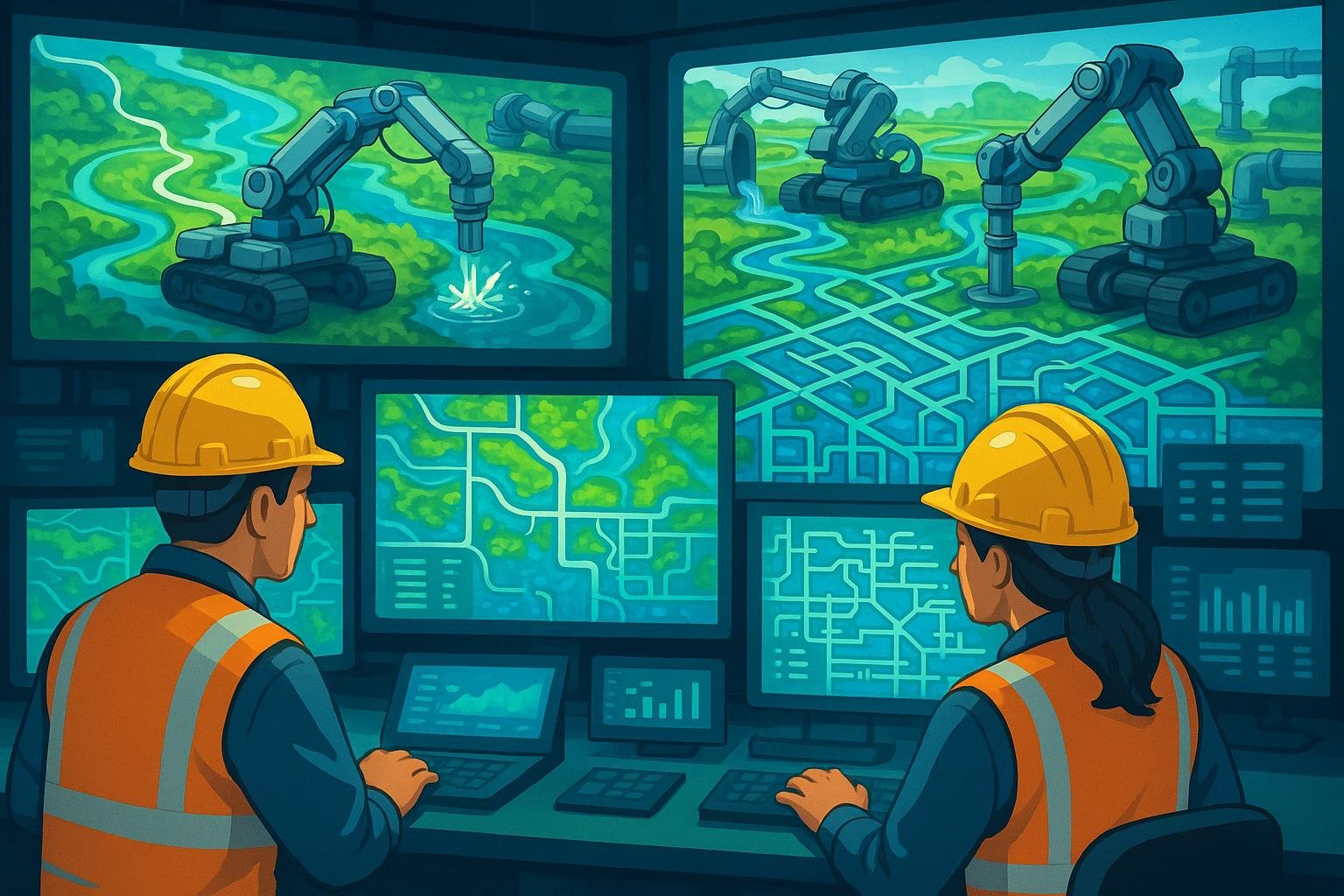
Generative AI is increasingly being adopted by water and wastewater utilities not to replace staff, but to enhance operational knowledge, improve fault resolution, and optimise resources amidst aging infrastructure and staffing challenges.

The prospect of artificial intelligence displacing utility staff has been a persistent fear among water and wastewater professionals. Yet practitioners deploying generative AI argue the technology is more likely to augment operatorsâ€...
Continue Reading This Article
Enjoy this article as well as all of our content, including reports, news, tips and more.
By registering or signing into your SRM Today account, you agree to SRM Today's Terms of Use and consent to the processing of your personal information as described in our Privacy Policy.
TeamSolve’s practical approach centres on a domain-specific platform the company calls Knowledge Twin. The system ingests sources such as CMMS records, SCADA telemetry, standard operating procedures and field reports to give operators, engineers and maintenance crews near‑real‑time access to context and historic insight. Terrien says early pilots show staff resolve faults more quickly, locate the information they need with less friction and preserve expertise that otherwise would have been lost through turnover.
The potential operational gains mirror wider industry findings. According to Autodesk, AI-driven optimisation of energy use, predictive maintenance and demand forecasting can cut operating expenditure by roughly 20–30%. WaterOnline and other sector commentators have documented examples of AI and IoT working together to reduce leaks, trim pumping energy and improve scheduling, sometimes delivering energy savings in the order of 20–25%.
Beyond cost and energy metrics, generative AI can change how unusual or emergency conditions are handled. Terrien describes an instance where an operator confronted with an unfamiliar transient was able to retrieve an automated operational history indicating the event was previously recorded and non‑critical, preventing an unnecessary escalation. Other industry pieces note generative models’ strength at synthesising large volumes of data into plain‑language guidance or suggested actions, while also supporting anomaly detection that flags deviations from expected patterns.
Adoption has accelerated but remains uneven. A 2024 survey reported by a sector publication found 78% of organisations were using AI, up markedly from the prior year, yet many utilities still cite hurdles such as fragmented legacy systems, data quality challenges and limited budgets. PwC and ASUG both emphasise that while data modernisation helps, organisations do not always need a perfect data estate to begin extracting value, clean, well‑organised subsets of data can be leveraged to build useful pilot projects and virtual assistants.
Practical deployments underscore these points. One East Coast utility that previously tracked maintenance events by hand moved to digitised collection and a consolidated knowledge base; the utility then used generative tooling to automate regular reporting, substantially reducing manual effort. International examples show operators using AI recommendations to determine chemical dosing or next steps during incidents, and predictive analytics have been used to forecast breaks or supply interruptions so interventions can be prioritised before failures occur.
Industry advisers stress governance and staged adoption. Terrien and TeamSolve advocate integrating generative AI where data maturity allows and prioritising safe, scalable rollouts that involve operators from the start. Commentary from consultancies highlights the need for clear audit trails, human‑in‑the‑loop controls and continuous validation so recommendations remain reliable and accountable.
As utilities face ageing infrastructure, shrinking workforces and growing operational complexity, vendors and practitioners present generative AI as a tool to raise efficiency, protect institutional knowledge and strengthen frontline decision‑making. According to TeamSolve’s recent work and wider industry reporting, the most effective implementations are those that treat AI as an assistant to experienced staff rather than as a substitute, pairing automated insight with operator judgement and established procedures.
Source: Noah Wire Services
Subscribe to Industry Updates