


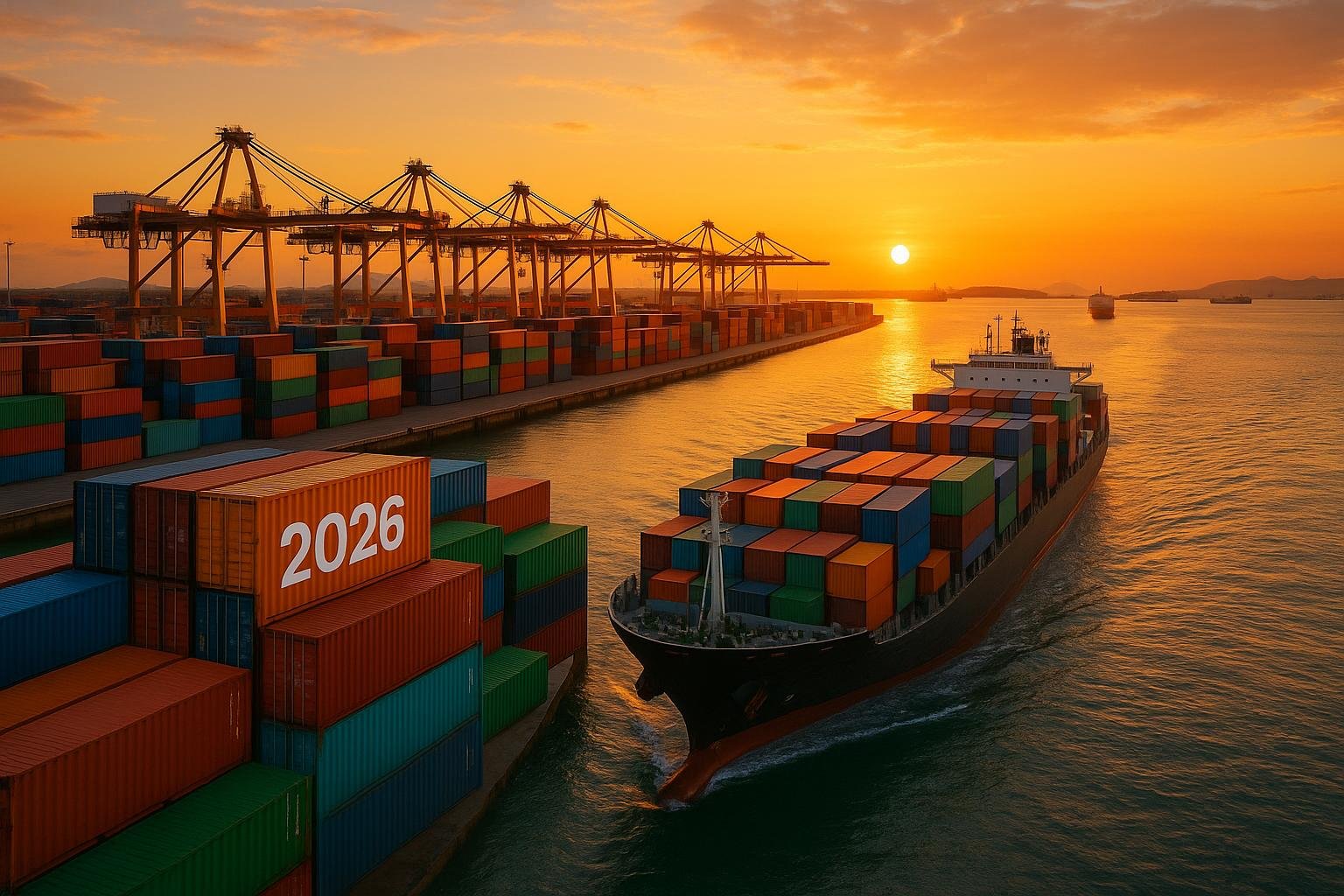
Senior corporate leaders expect stable or growing trade in 2026 amid high policy uncertainty, prioritising diversified networks and operational resilience over reshoring efforts, according to DP World’s annual outlook.

Senior corporate executives entered 2026 with guarded optimism about international commerce, favouring broader supplier networks over retreat from contested markets as the dominant strategic response to persistent policy risk. The DP World Global Trade ...
Continue Reading This Article
Enjoy this article as well as all of our content, including reports, news, tips and more.
By registering or signing into your SRM Today account, you agree to SRM Today's Terms of Use and consent to the processing of your personal information as described in our Privacy Policy.
The survey, which draws on responses from more than 3,500 senior supply‑chain and logistics leaders according to DP World’s platform, reports that 94% of respondents anticipate trade will remain stable or expand in 2026. At the same time 53% judge policy uncertainty to be high or very high, and roughly nine in ten expect trade barriers to rise or persist. Those figures underline a disjunction between demand expectations and the external risks companies now factor into planning.
Geography matters in executives’ calculations. Europe and China emerged most often as the locations where growth is likely to appear, cited by 22% and 17% of respondents respectively, followed by Asia‑Pacific and North America. Within Asia, sentiment varies significantly: Thailand stands out for strong upbeat forecasts, with 73% of local executives expecting faster trade growth in 2026, while Indonesia, the Philippines and China reported 61%, 50% and 42% positivity respectively. DP World and independent analysts say Europe’s rebound is tied to stabilising industrial demand and logistics flows, whereas confidence in China is increasingly linked to intra‑regional trade and supply‑chain integration rather than a pure export rebound.
Faced with friction and unpredictability, firms are prioritising diversification over wholesale reshoring. The report highlights supplier expansion and selective realignment as the most common tactics. In China and Indonesia, increasing the number of suppliers is the top diversification move for 69% and 66% of respondents respectively, while firms in Thailand and the Philippines are more likely to pursue friendshoring, with 52% and 48% giving it priority. DP World characterises these choices as a shift toward network optionality , preserving access to key markets while spreading operational risk across multiple partners and routes.
Operational data are becoming more important as early indicators of changing trade patterns. Shipping and customs records now point analysts toward micro‑signals , such as cross‑border clearance speeds, supplier fill‑rate consistency and the performance of secondary corridors , which can presage broader shifts in volumes and costs. The report argues that companies which weight these granular metrics more heavily can identify emerging pressure points and act pre‑emptively to protect service levels.
The broader industry backdrop gives context to the strategic pivot. DP World itself reported record container handling in 2024, with 88.3 million twenty‑foot equivalent units processed , an increase of 8.3% year‑on‑year , underscoring capacity and demand resilience across multiple regions. The company also announced a $2.5 billion logistics infrastructure investment in 2025 aimed at expanding its footprint in India, Africa, South America and Europe, a move it says will bolster end‑to‑end supply‑chain capabilities.
Regional nuances punctuate the global picture. According to DP World, executives in the United Arab Emirates display notably strong confidence for 2026, with nearly two thirds expecting trade to match or exceed 2025 levels; commentators attribute this to sustained infrastructure investment, advanced logistics and early digital adoption that have strengthened the UAE’s trade position. Yet the broader survey results make clear that optimism is conditional and strategic responses will continue to vary by market, sector and corporate risk appetite.
As companies navigate the year ahead they are less focused on a return to frictionless trade than on building flexible, multi‑node networks that can absorb shocks. Industry data and the Observatory’s survey together suggest that the immediate challenge for trade leaders is not if growth will occur, but how to capture it while managing an elevated, unpredictable policy environment.
Source: Noah Wire Services
Subscribe to Industry Updates

