


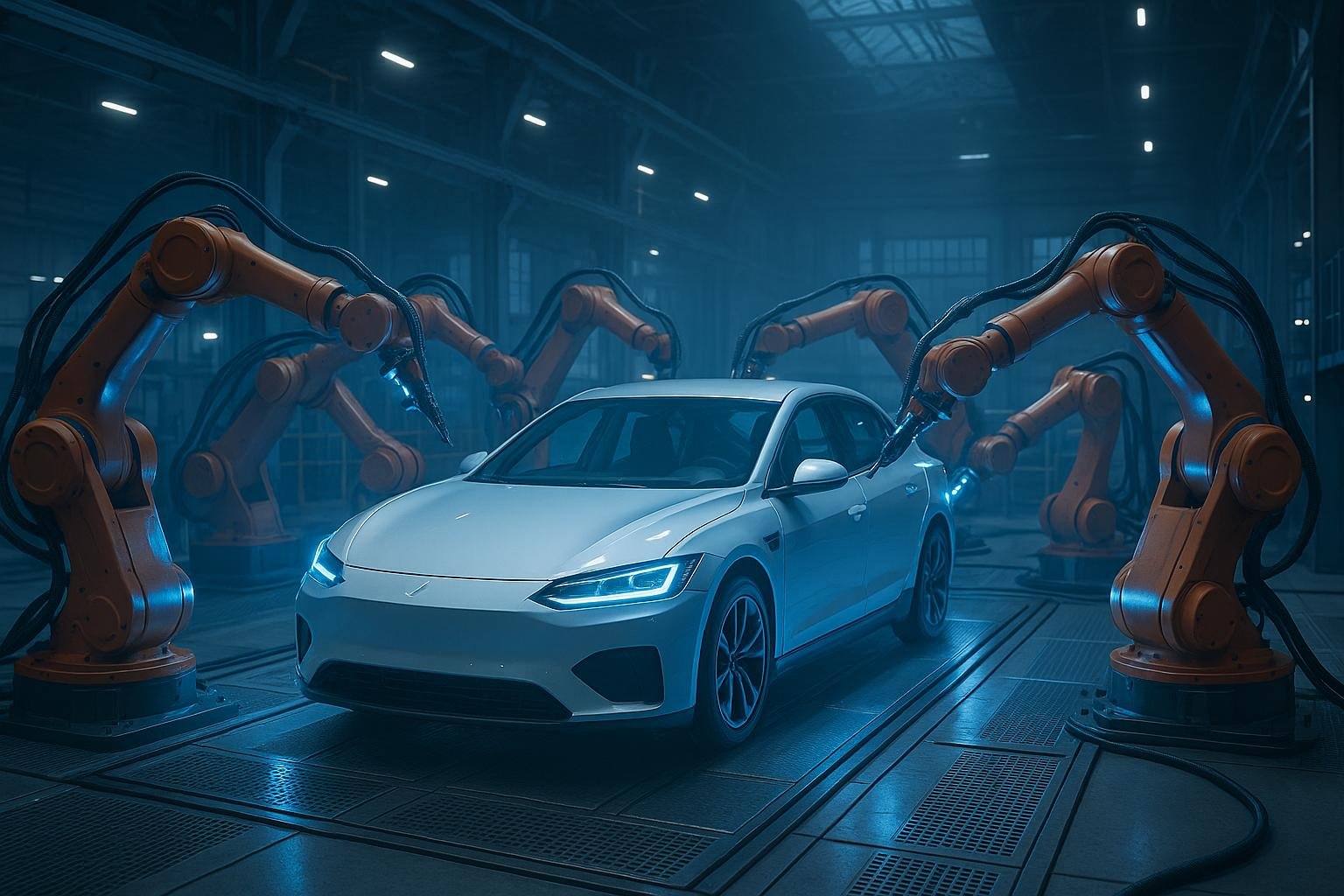
Europe’s car factories are undergoing a revolutionary transformation as AI, robotics, and electrification converge, promising increased efficiency but also posing challenges for workforce reskilling and supply chains.

Europe’s automotive factories are in the midst of a rapid technological shift as artificial intelligence, robotics and the electric vehicle transition converge to reshape vehicle production across the continent. According to the original report, the Eu...
Continue Reading This Article
Enjoy this article as well as all of our content, including reports, news, tips and more.
By registering or signing into your SRM Today account, you agree to SRM Today's Terms of Use and consent to the processing of your personal information as described in our Privacy Policy.
The scope of automotive robotics now spans traditional industrial arms and laser welding systems to AI-enabled controllers, machine-vision inspection, collaborative robots (cobots) and mobile logistics platforms. The original report highlights battery assembly, cell packaging and high‑precision joining among EV-era tasks that are accelerating demand for specialised automation. It also notes that cobots, which operate safely alongside human workers, are increasingly used for interior fitment, electronics handling and inspection tasks where human dexterity and robotic repeatability combine.
Policy and industrial initiatives are sharpening that momentum, but details and scale vary between sources. The lead article refers to a February 2025 InvestAI initiative worth €200 billion to accelerate AI integration in critical industries , a measure presented there as a defining moment for robotics autonomy. Separately, Reuters reported European Commission President Ursula von der Leyen urging a Europe‑wide push on self‑driving cars and pilot networks in cities, and the Commission announced an “Apply AI” strategy in October 2025 with funding measures intended to reduce reliance on non‑EU technology and accelerate AI adoption in sectors including automotive manufacturing. Industry observers and policymakers frame both moves as part of a broader push to secure industrial competitiveness against pressures from China and the United States.
Market data from other research firms points to similar, though not identical, growth expectations and underlines the diversity of the robotics opportunity. Industry data shows the Europe articulated-robot market was valued at about US$5,637 million in 2024 and is projected to reach roughly US$11,801 million by 2033, reflecting demand in heavy‑duty welding, painting and material handling. Separate estimates put the collaborative-robot share of European automation at more than 30% within automotive applications in 2024, underscoring how manufacturers are combining human and machine labour rather than replacing it outright.
Manufacturing adoption is uneven but notable. According to a 2025 Rockwell Automation report, 53% of UK manufacturers were already using AI on the factory floor, with 98% planning implementation , rates above global averages , driven by computer vision for quality control and predictive maintenance that reduce defects and operating costs. Government support is also being directed towards modernisation: the original report cites a UK funding package announced in June 2024 including allocations for automotive electrification and automation, while national deployments across Germany, France, Italy and Spain illustrate diverse pathways to smarter production.
The technology stack is evolving. Sensors and vision systems have become the “eyes” of production; intelligent controllers and edge computing provide low‑latency decisioning; flexible end‑effectors and multi‑axis robotic arms deliver the precision required for battery modules and lightweight structures; and digital twins, cloud analytics and IoT enable real‑time monitoring and process optimisation. Major automation suppliers , ABB, FANUC, KUKA, Yaskawa, Omron and others , continue to invest in AI integration, collaborative control and software ecosystems that link robots to enterprise systems.
Despite enthusiasm and policy support, barriers remain. High initial capital expenditure for robotics hardware, systems integration and factory retrofits continues to constrain adoption, particularly among small and medium-sized suppliers. The original report flags workforce displacement and a pronounced skills gap: industry is shifting demand from manual assembly roles to robotics programming, systems integration and AI‑model monitoring, and many countries are racing to scale reskilling programmes. Supply‑chain complexity for EV batteries and the need for new safety and regulatory frameworks for autonomous systems add further friction.
There are also discrepancies in forecasting that reflect different methodologies and timeframes. The original report’s US$7.37 billion by 2033 forecast is closely echoed in projections showing robust double‑digit growth; other market studies estimate slightly different baselines and end‑points but similarly strong expansion through the next decade. Industry analysts point out that articulated robots will continue to dominate traditional body‑in‑white and paint operations while Cartesian and SCARA systems expand where precision, repeatability and vertical integration for EV components are required.
European automakers and suppliers are responding with a mix of capital projects and partnerships. Examples cited in the coverage include large logistics and mobile‑robot deployments in Germany and experimentation with autonomous last‑mile systems in the UK and Italy. The company statements and deployment case studies supporting these moves are presented by vendors and automotive groups as demonstrators of scalability, though independent reviewers caution that pilot projects do not always scale cost‑effectively to full production.
Looking ahead, the intersection of AI policy, EV demand and factory modernisation suggests that robotics will be central to Europe’s industrial strategy. The original report’s view of robotics as the gateway to higher efficiency, lower per‑unit costs and improved quality captures industry sentiment, while government strategies and private investment plans indicate that competition to lead in AI‑driven automotive manufacturing will intensify. For manufacturers, investors and policymakers alike, the challenge will be to translate pilot projects and policy pledges into widespread, cost‑effective deployments that also address workforce transition and supply‑chain resilience.
Source: Noah Wire Services
Subscribe to Industry Updates

