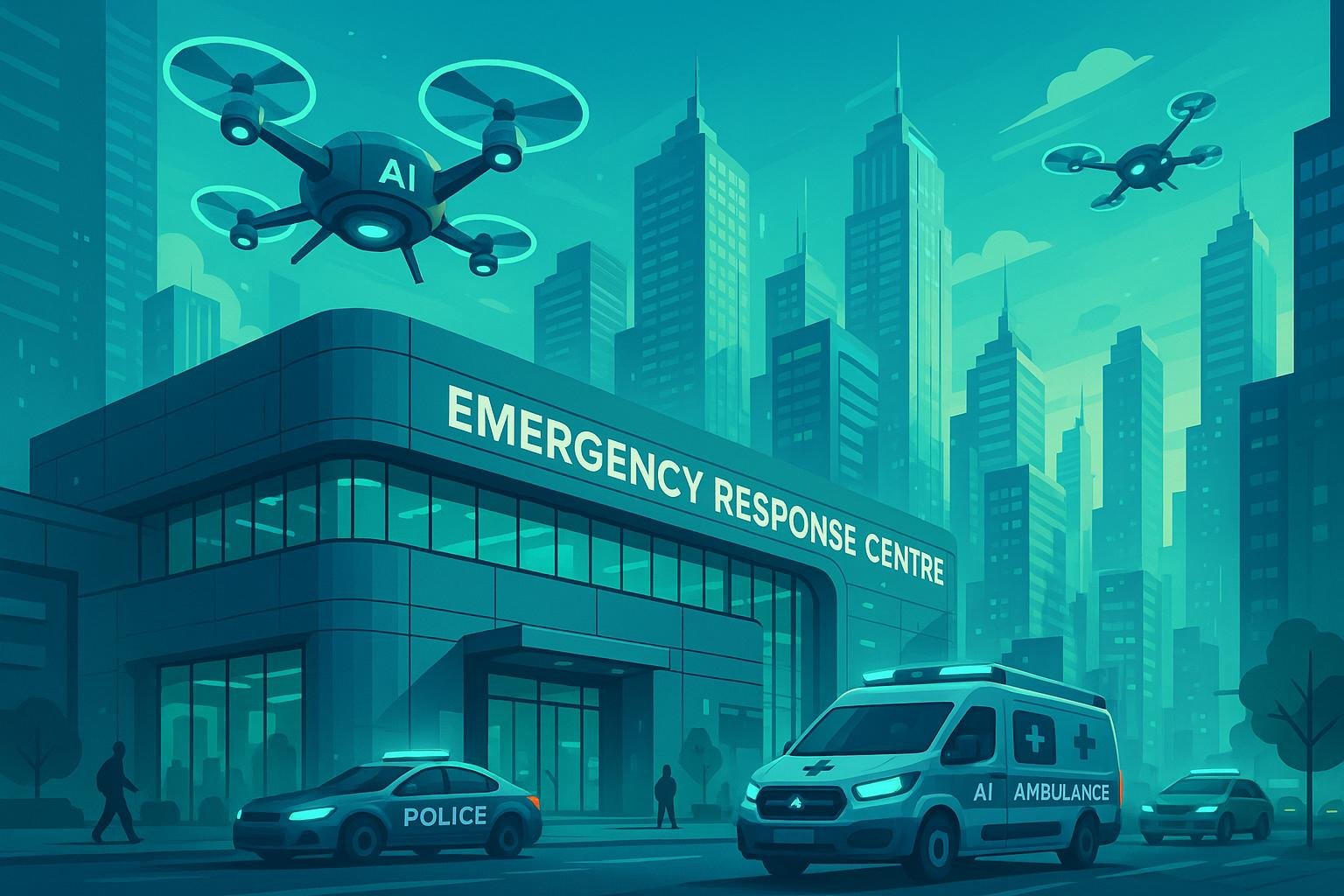
The market for intelligent emergency response systems and infrastructure is expanding rapidly as governments and industry invest in technologies to shorten reaction times, improve situational awareness and bolster resilience against both natural and human-made threats. According to a market study by DataM Intelligence, the sector grew to US$1.3 billion in 2022 and is expected to reach US$2.1 billion by 2030, driven by urbanisation, smart‑city programmes and the integration of Intern...
Continue Reading This Article
Enjoy this article as well as all of our content, including reports, news, tips and more.
By registering or signing into your SRM Today account, you agree to SRM Today's Terms of Use and consent to the processing of your personal information as described in our Privacy Policy.
et of Things sensors, artificial intelligence and cloud communications into emergency management frameworks.
Regional rollouts and modernisation efforts are accelerating that adoption. DataM Intelligence documents a series of developments in early 2026: major U.S. cities scaling AI‑powered emergency platforms and accelerating Next‑Generation 911 deployments that support multimedia and enhanced geolocation; Japan expanding IoT‑enabled seismic and flood warning networks and integrating robotics into search‑and‑rescue; European Union civil protection programmes layering AI and satellite data for cross‑border coordination; and APAC nations embedding predictive analytics and automated alerts into public warning systems. The report also highlights a growing emphasis on cyber‑resilience, with zero‑trust architectures and secure cloud platforms being adopted to protect mission‑critical communications.
Market segmentation underscores how purchasers are seeking unified safety architectures. DataM Intelligence notes that physical security (surveillance and access control) is increasingly converged with life‑safety solutions such as fire detection and evacuation management to create centralised command platforms that coordinate responses across sites and agencies. Hardware, sensors, cameras and communications equipment, remains foundational, but software platforms that enable data fusion, predictive analytics and workflow automation are becoming the principal differentiator. Service models covering integration, managed operations and maintenance are likewise expanding, reducing upfront capital barriers and improving scalability.
Communication and deployment choices are shaping procurement. The market shows a clear tilt to wireless communications for rapid, distributed deployments and to cloud‑hosted platforms for their remote accessibility and ease of integration with advanced analytics. These trends support geographically dispersed command and control as well as faster updates and scalability during crises.
Adoption is broadening across sectors. Government and public safety agencies are the primary customers, but critical infrastructure operators in energy, transportation and oil & gas are stepping up investments to prevent accidents and meet regulatory obligations. Education, healthcare and industrial campuses are also deploying integrated systems to protect people and assets and to streamline incident response.
The competitive landscape is crowded and varied. DataM Intelligence lists vendors such as Axis Communications AB, BlackBerry AtHoc Inc., Cobalt Inc., FPT Software, Eaton Corporation PLC, Enera Inc., Everbridge, Inc., Honeywell International, Inc., RapidSOS and Robert Bosch GmbH as active participants pursuing analytics, AI‑enabled detection and cloud communications alongside partnerships with public authorities. Other market studies present different leading names and emphases, reflecting varied methodologies and scope.
Notably, independent estimates diverge on market size and growth. ASD Reports forecasts growth from US$1.54 billion in 2023 to US$2.48 billion by 2030 at a 6.96% CAGR. GIIG Research and Research and Markets both estimate the market at roughly US$1.36 billion for 2024 with a projection to about US$1.88 billion by 2029 at a 6.64% CAGR. MarketResearch.com places the 2024 value higher, at roughly US$1.7 billion growing to US$2.3 billion by 2030 at a 5.1% CAGR. A markedly larger projection appears in a press release from Global Industry Analysts Inc., which puts the opportunity at US$117.2 billion by 2026; that estimate appears to reflect a substantially broader definition of addressable markets. These discrepancies illustrate how differences in definitions, included system components, geographic scope and time horizons can materially affect market totals and growth rates.
Technological advances and operational experience are shaping priorities. The use of drones and robotics for aerial surveillance, damage assessment and hazardous‑environment operations is becoming mainstream in several markets. AI‑driven analytics applied to video, sensor streams and communications are being used to detect anomalies, prioritise responses and predict incident escalation. Integration of satellite imagery and remote sensing is improving situational awareness in areas that are hard to access. At the same time, cybersecurity measures are being elevated from an afterthought to a core requirement as more emergency systems rely on networked and cloud components.
Looking ahead, demand is likely to remain resilient because of rising climate risks, urban density and the strategic importance of rapid, coordinated responses. Industry observers cited in the assorted reports expect continued investment in interoperable platforms, tighter public‑private collaboration and service‑oriented procurement models that favour subscription and managed offerings. How quickly organisations migrate legacy infrastructures to AI‑enabled, cloud‑native systems will be a key determinant of vendor opportunity and the pace at which capabilities translate into measurable improvements in public safety and critical‑infrastructure resilience.
Source: Noah Wire Services