


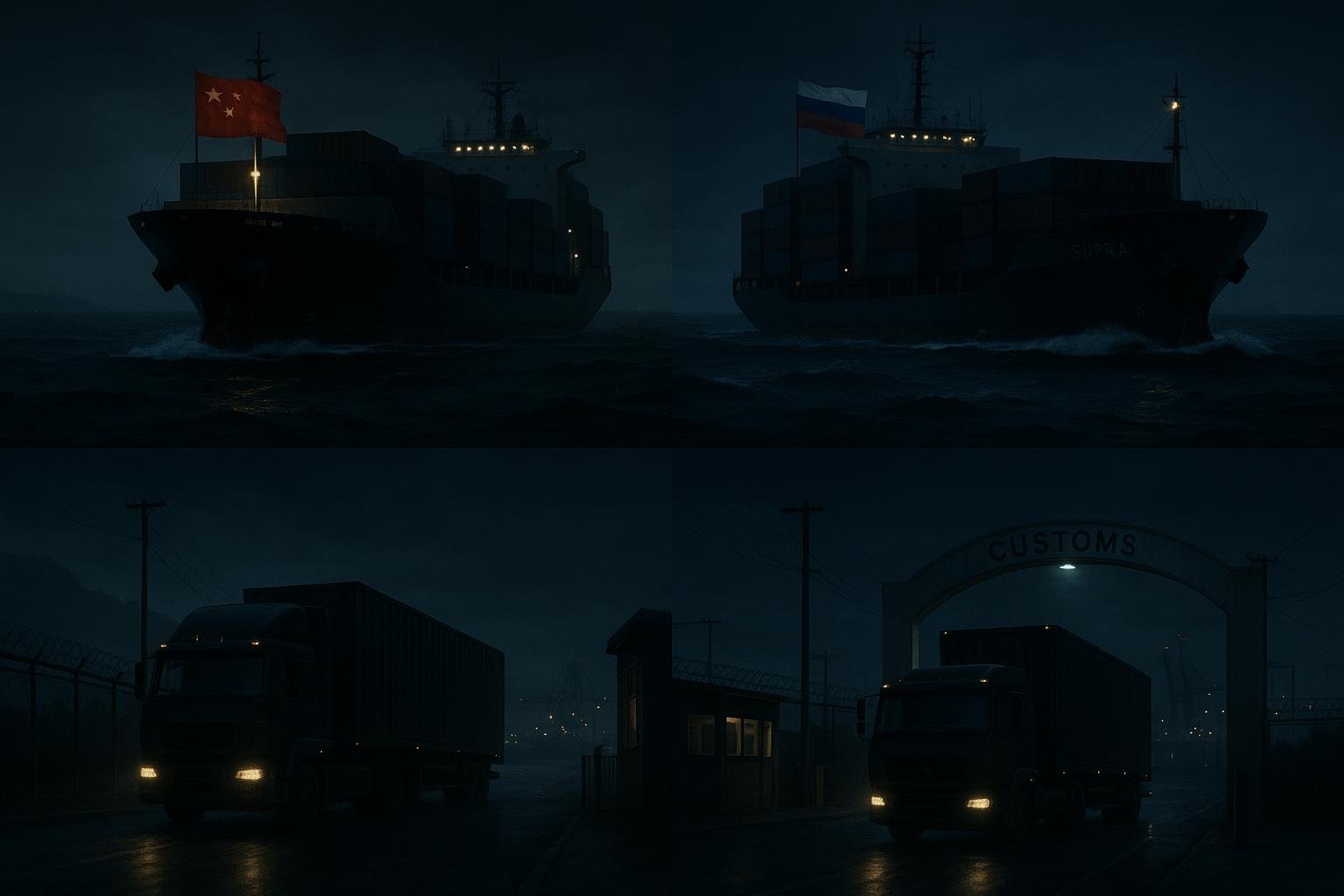
As the ongoing conflict involving the United States, Israel, and Iran intensifies, attention has increasingly focussed on how China and Russia, despite their apparent reluctance to engage militarily, are key enablers of Iran’s sustained military operations through complex economic and technological networks. Contrary to early assumptions that Beijing and Moscow might remain passive or neutral, deeper analysis reveals their integral role in circumventing Western sanctions and bolster...
Continue Reading This Article
Enjoy this article as well as all of our content, including reports, news, tips and more.

By registering or signing into your SRM Today account, you agree to SRM Today's Terms of Use and consent to the processing of your personal information as described in our Privacy Policy.
These networks, often referred to as the “Axis of Evasion,” comprise China, Russia, and Iran collaborating to bypass the extensive sanctions imposed by the United States and its allies. The Atlantic Council’s GeoEconomics Center highlights that these countries exploit integrated supply chains that allow circumventing Western export controls, particularly because transactions occur outside the Western financial system. This system has grown resilient against sanction enforcement and enables persistent Iranian military development despite almost two decades of comprehensive economic restrictions.
China is central to this dynamic. It imports Iranian oil despite sanctions and supplies Iran with sophisticated dual-use technologies, including drone components, navigation systems, and chemical precursors vital for rockets and explosives. Research and reports underscore how Iranian drones such as the Shahed series heavily rely on components sourced from Western, Japanese, and American manufacturers but rerouted through Chinese intermediaries. Chinese markets and distributors act as hubs that not only provide parts originally designed for civilian use but also facilitate their integration into weapons systems. China’s strategic partnership with Iran, formalised in early 2024, has further spiked these exports.
Russia complements this arrangement by sharing drone technology and production expertise with Tehran. Since 2022, the two nations have intertwined their defence industrial capacities, with Russia establishing production facilities for Iranian drones and modifying them to fit its own military needs in Ukraine. By 2025, about 90 percent of Shahed drone assembly reportedly shifted to Russia. Ukrainian officials, including President Volodymyr Zelenskyy, have noted that Russia is now supplying Iran with Russian-made drones for use against US and Israeli targets, illustrating the self-reinforcing and evolving nature of the partnership. Chinese specialists have also reportedly assisted Russia in drone development, including the advanced Garpiya-3 drone, demonstrating a triangulated cooperation that spans continents and sanctions regimes.
The supply chain extends beyond drones. Navigation technology, an essential enabler of drone accuracy, is being transferred from China and Russia to Iran. Chinese access to the BeiDou satellite system has allowed Iran to disrupt enemy reconnaissance efforts by producing decoy signals that confuse Western and Israeli intelligence. The US Treasury has repeatedly imposed sanctions on Chinese firms and fronts involved in supplying gyro navigation devices and sensors to Iran, but enforcement challenges persist due to the use of shell companies and transshipment hubs.
Similarly, Iran’s missile and explosives programmes rely on chemical precursors sourced from China. The sprawling nature of China’s chemical industry and the diffuse global trade networks make it difficult to track and control shipments, resulting in Iranian access to vital materials for solid rocket fuels through intermediated trade. Recent reports indicate that Iranian shadow vessels transporting rocket fuel precursors often originate from Chinese ports, underscoring the ongoing material support gradient that sustains Tehran’s military-industrial complex.
The United States has responded with a series of sanctions aimed at disrupting these supply networks. The Treasury Department has targeted various Chinese and Iranian front companies and individuals involved in the procurement and shipment of drone components. For instance, in December 2023, sanctions were placed on a network accused of illegally exporting US-made microelectronics to Iran, components found in drones active both in Ukraine and the Middle East. Earlier, in September 2022, Washington sanctioned Tehran-based Safiran Airport Services for facilitating drone shipments to Russia. Despite these efforts, consistent enforcement remains a daunting challenge, given the shadowy networks exploiting third-party countries for transshipment and disguise.
Experts emphasise that focusing on China alone is insufficient to fully impede Iran’s military build-up. Iranian procurement depends on a web of distributors, logistics firms, and transshipment hubs across multiple jurisdictions, many of which lack the political will or regulatory capacity to enforce export controls robustly. These third countries, often economically pressured and hit by US tariffs, may unwittingly or reluctantly enable Iran’s evasion strategies. Consequently, analysts urge the US to implement a multifaceted approach that combines targeted sanctions with international cooperation, intelligence sharing, and incentives encouraging capacity building in customs enforcement and export control compliance.
China’s role goes beyond simple trade facilitation. It has entrenched itself economically with Iran through mechanisms like a covert oil-for-infrastructure payment network and barter schemes involving sanctioned sectors such as automobiles and metals. This deep economic integration creates parallel financial and trade systems that undercut the effectiveness of US sanctions, allowing Iran not only to sustain but enlarge its export flows and reimport vital goods.
Moreover, the collaboration reflects a strategic calculation rather than mere economic opportunism. Russia benefits from the global oil supply shocks caused by the conflict, while China leverages its dominance in rare-earth minerals and technology pathways to maintain leverage in this geopolitical tussle. Though China’s President Xi Jinping and Russia’s President Vladimir Putin appear cautious about direct military entanglements in the region, their governments tacitly support and enable Iran’s military-industrial resilience through this Axis of Evasion.
With the Trump administration refocusing its attention on the Middle East and a delayed summit with Xi Jinping, there are calls for a robust diplomatic and enforcement strategy that directly confronts China on its role in facilitating Iran’s military capabilities. This would involve tightening scrutiny on Chinese exporters, intermediaries, and distributors of dual-use goods, alongside expanded entity listings and demand for enhanced export transparency.
In sum, the ongoing US-led sanctions campaign faces significant obstacles posed by the sophisticated, multinational networks between China, Russia, and Iran that allow Tehran to continue producing and exporting drones and missile technologies. Overcoming this challenge requires an integrated and persistent effort to dismantle supply-chain evasions, bolster allied enforcement capacities, and address the geopolitical undercurrents driving this Axis of Evasion. Without such comprehensive measures, Iran’s ability to regenerate its advanced weapons programmes, and by extension, perpetuate regional instability, will endure despite Western efforts to contain it.
Source: Noah Wire Services
Subscribe to Industry Updates

