


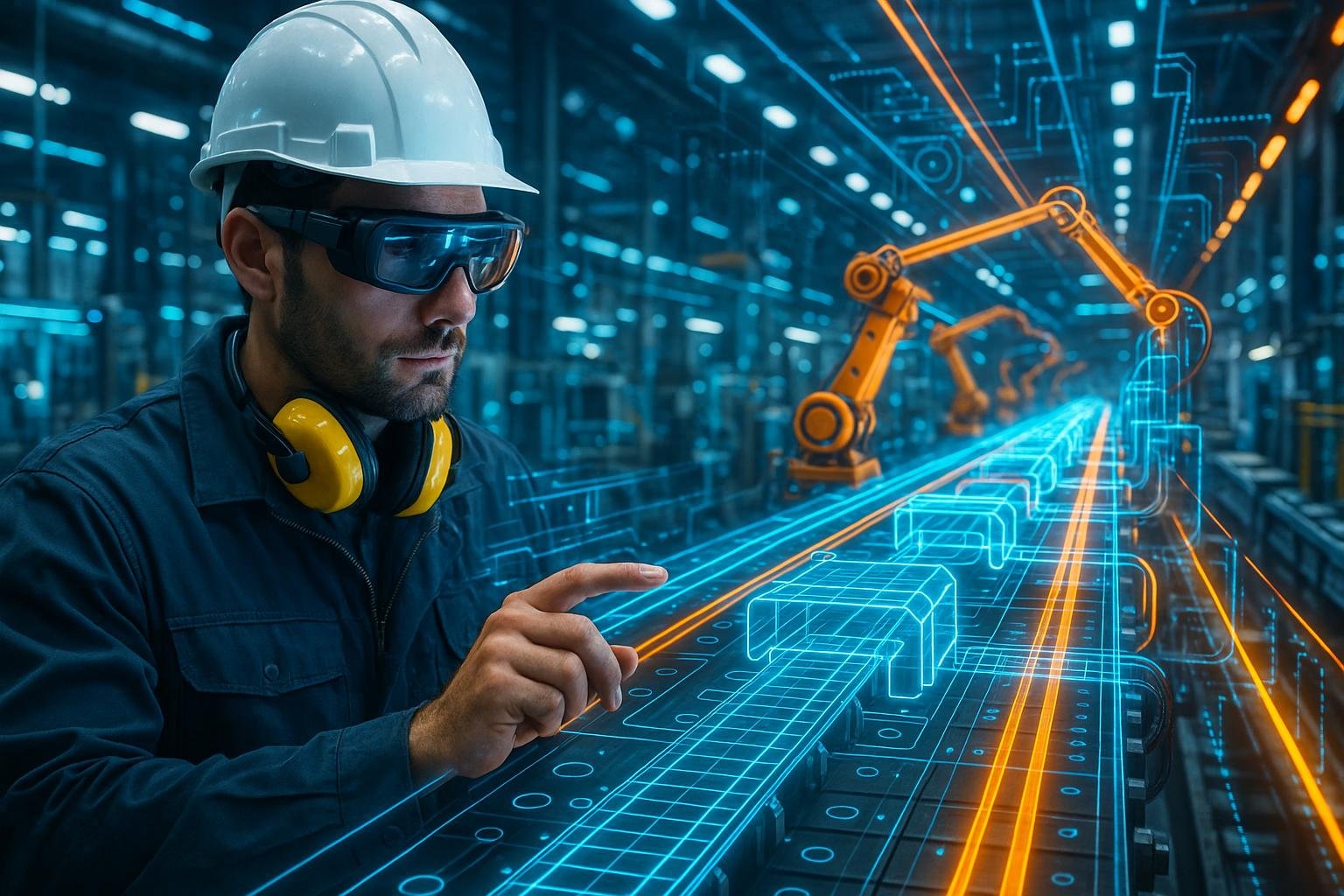
AR technology is transforming factory operations by boosting efficiency, reducing errors, and enhancing safety, marking a new era in industrial productivity and workforce agility.

Augmented reality (AR) is revolutionising manufacturing by transforming factory workers into “super operators” equipped with real-time digital guidance, quality checks, remote expert support, immersive training, and IoT-driven maintenance insights. This wave of technological integration is delivering remarkable productivity gains , with studies and case examples showing 25–45% improvements in speed, accuracy, and equipment uptime.
Traditional factory environments, long dominated by paper instructions and reactive problem-solving, are being fundamentally reshaped. Today, technicians wearing lightweight smart glasses receive step-by-step assembly instructions overlaid directly onto machinery components. Complex inspection tasks benefit from instant digital defect highlighting, while remote experts offer interactive, annotated guidance regardless of physical distance. These applications are no longer futuristic concepts but are actively deployed , Boeing, for instance, reduced wiring assembly time by 25% and cut errors to near zero using AR, while General Electric’s service teams complete repairs about 34% faster.
AR technologies operate by augmenting the physical environment with digitally layered information via smart glasses, tablets, or smartphones. Rather than replacing the workforce or existing systems, AR amplifies human capability, effectively providing workers with enhanced perception and memory. This capability is enabling major operational improvements across several key manufacturing workflows:
- Guided assembly benefits from precise, progressive visual instructions which Lockheed Martin applied to cut spacecraft assembly times by 42%, achieving near-zero rework.
- Real-time quality inspection systems, such as Porsche’s AR-enabled vehicle inspections, transform quality control from a stop-and-check process into continuous, automated defect detection, allowing immediate remediation and the preventative identification of root causes.
- Remote expert assistance platforms, exemplified by PTC’s Vuforia Chalk, reduce troubleshooting time by up to 40% by offering interactive support from anywhere in the world.
- Immersive AR training drastically compresses onboarding times, with automotive suppliers reporting reductions from six weeks to two and improved retention and performance.
- Predictive maintenance is enhanced by integrating IoT sensor data into AR displays, allowing technicians to visualise machine health metrics in real time and perform contextual repairs more quickly, as demonstrated by ThyssenKrupp.
- Digital twin visualisation overlays virtual replicas of production lines on factory floors, helping managers identify inefficiencies and bottlenecks instantly.
- Warehouse operations improve efficiency through AR-guided picking routes, inventory management, and batch identification, with DHL achieving 15% productivity gains.
Successful AR implementation hinges on selecting durable, comfortable hardware suited to industrial environments, ensuring seamless integration with existing Manufacturing Execution Systems (MES), Enterprise Resource Planning (ERP), and quality management platforms, and adopting a phased deployment strategy to build organisational buy-in and optimise workflows. Content creation, once a bottleneck requiring specialised skills, is now accelerated through CAD integration, AI-assisted video capture, template libraries, and no-code authoring tools , though maintaining up-to-date AR content remains a critical challenge.
The financial impact of AR adoption is significant. Training costs drop by 40-60%, with Boeing’s wire harness assembly case saving over $1,000 per trainee. Error rates plummet , Lockheed Martin approaches near-zero defects on complex assemblies, while GE Healthcare reported a 46% error reduction in warehouse operations. The consequent reduction in product rework and warranty claims leads to rapid payback on AR investments. Over the longer term, companies report strategic advantages including 25-35% faster new product introduction, workforce flexibility improvements of 2-3 times, enhanced knowledge retention, and heightened customer satisfaction scores.
The global AR and VR market in manufacturing is also expanding swiftly. Industry analyses forecast compound annual growth rates exceeding 24%, spurred by the adoption of Industry 4.0 technologies, government initiatives, and investments in research and development. The U.S. currently leads in market share thanks to widespread Industry 4.0 integration, with the Asia-Pacific region expected to see the highest growth, driven by technology rollouts in China and Japan.
Research further confirms AR’s role in boosting safety and operational efficiency. Studies demonstrate up to 35% reductions in safety incidents due to real-time hazard warnings and procedural compliance facilitated by AR. Additionally, AR-enabled human-robot collaboration environments have reported significant decreases in task completion times and robot idle periods alongside improved safety outcomes.
As AR matures from pilot projects to production scale, the competitive differentiation lies not in mere experimentation but how quickly manufacturers embed AR into high-value use cases, integrate it with core enterprise systems, and scale content and training effectively. Leading manufacturers are realising that augmented reality does not supplant human workers but extends their capabilities, enabling them to learn complex procedures rapidly, identify defects early, and access expert support on demand.
The factories leading this transformation may look familiar from a distance, yet the workforce inside operates with enhanced vision and knowledge, defining a new era where operational precision and workforce agility set the pace for success. For manufacturers, the imperative is clear: start small, validate the benefits, and scale swiftly, or risk falling behind competitors already harnessing the power of AR to redefine what is possible on the factory floor.
Source: Noah Wire Services

