


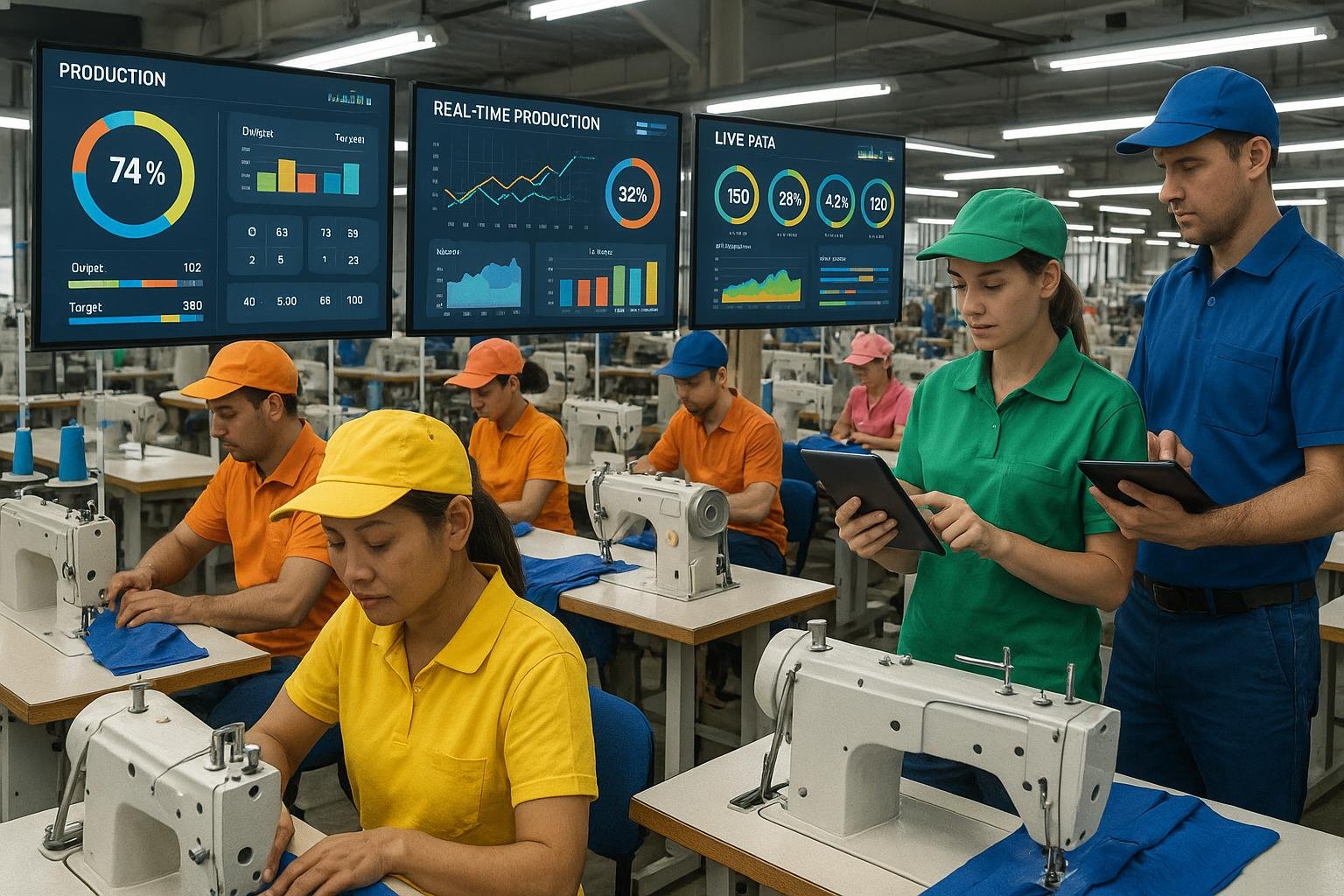
Manufacturers in Canada, Sri Lanka, and Egypt are shifting from paper-based reporting to live data-driven systems, boosting efficiency, on-time delivery, and labour cost savings as industry standards evolve towards smarter, connected factories.

For apparel manufacturers confronting thin margins and fast-moving orders, the old reliance on paper and end-of-day reports is rapidly giving way to live, data-driven shop floors. Case studies from Canada, Sri Lanka and Egypt und...
Continue Reading This Article
Enjoy this article as well as all of our content, including reports, news, tips and more.
By registering or signing into your SRM Today account, you agree to SRM Today's Terms of Use and consent to the processing of your personal information as described in our Privacy Policy.
At INNOTEX® in Montréal the change centred on replacing hand-written collection sheets with tablets running a shop-floor application. According to a LinkedIn post by the company, once the BlueCherry® Shop Floor Control module was fully rolled out the plant retired its manual papers and shifted responsibility for data capture to the operators at each sewing station. The company said managers now access live dashboards and that automated links between production data and payroll have removed a layer of administrative error. INNOTEX® framed the move as aligned with Industry 4.0 and as a step toward a “smart, connected, and agile factory, where every piece of data becomes an opportunity for improvement.”
A different path to the same end is illustrated by Star Garments Group in Sri Lanka. The firm fitted RFID tags to bundles at the first cut and extended the system across 10 production units, creating what it describes on LinkedIn as “Wall-to-Wall Transparency.” That visibility, the company said, captures progress to the level of individual machines and operators, enabling managers to spot where work-in-progress accumulates and to clear bottlenecks before they delay shipments. Star Garments reported the system “accelerates production efficiency for our clients, from start to finish.”
Delta Galil’s Elmania 2 facility in Egypt offers a data-rich example of outcomes once real-time control is embedded across multiple lines. In a LinkedIn video the Vice President of Delta Galil Egypt credited RFID integration and station-level tablets with lifting line efficiency from 62% to 79%, tightening on-time delivery to about 99% and improving quality. “What kind of benefit we achieve? First of all, our efficiency increased from 62% to 79%. Our on time delivery reached around to 99%… our quality performance improved. Once we improve our efficiency, we reduce our overtime and we make a lot of improvement in the cost reduction,” he said. He added that the workforce responded positively when operators could view their own efficiency and bonus information: “I’m completely supporting this idea and supporting my team and team is responding very well… in real time we can see all the activities and without losing any time we are tracking the point where we have a gap, where we have a issue and we immediately control the things.”
Those manufacturer accounts are consistent with vendor claims and independent implementations documented elsewhere. According to a BlueCherry® case study, Confexsa, a workwear maker, gained roughly 10% productivity uplift and better operator engagement after deploying the vendor’s Shop Floor Control, with multilingual interfaces easing onboarding and real-time WIP visibility helping prevent bottlenecks. Joseph Abboud’s adoption of the same BlueCherry® module is presented in a separate case study as enabling more than a 40% improvement in efficiency while supporting a “Made in the USA” strategy through reduced cycle times and tighter process control. Dignity Apparel likewise reported enhanced workflow and faster identification of inefficiencies after going digital.
BlueCherry’s marketing materials quantify the potential gains more broadly, suggesting Shop Floor Control can boost manufacturing efficiency by up to 30%, cut costs by as much as 28% and reduce in-line defects by up to 45%. The product is built to integrate industrial tablets, IoT endpoints and ERP systems so factory events are captured at source and presented on dashboards accessible to managers and shop-floor staff alike.
Industry demonstrations and wider deployments reinforce the trend. At Texprocess Americas 2025 BlueCherry showcased integrated smart-manufacturing tools alongside machine partners, highlighting how combined ERP, PLM and quality-management capabilities can reduce waste and increase throughput. Separately, RFID implementations beyond the apparel brands have shown similar operational benefits; Lawsgroup, a Hong Kong contract manufacturer, reported that an RFID-based WIP tracking rollout across 15 Asian sites produced meaningful gains in responsiveness and output compared with manual tracking, according to RFID Journal.
Taken together, these examples point to a repeatable formula. Early digitisation activities tend to focus on three practical problems: real-time visibility of WIP, immediate identification of bottlenecks, and a dependable link between production output and pay. Where those three elements are achieved, employers report lower overtime, quicker reaction to problems and a room for managerial decisions to be based on live evidence rather than estimates.
There are caveats. Vendor case studies naturally emphasise best outcomes and may not reflect implementation hurdles such as integration with legacy ERP, staff training, RFID tag and reader costs, or the cultural change required for operators and supervisors to trust and act on live metrics. In that respect, the accounts from Delta Galil and Confexsa are notable for emphasising operator-facing interfaces and multilingual support, features that ease adoption and limit resistance.
For factories still reliant on paper, the implications are practical. Real-time shop-floor control is presented not as a luxury but as a competitive imperative: live data reduces guessing, lets teams clear chokepoints in minutes rather than days and links pay more transparently to output. As suppliers and early adopters publish efficiency and delivery improvements, digitised shop floors appear set to become the industry baseline rather than an optional upgrade.
Source: Noah Wire Services
Subscribe to Industry Updates

