


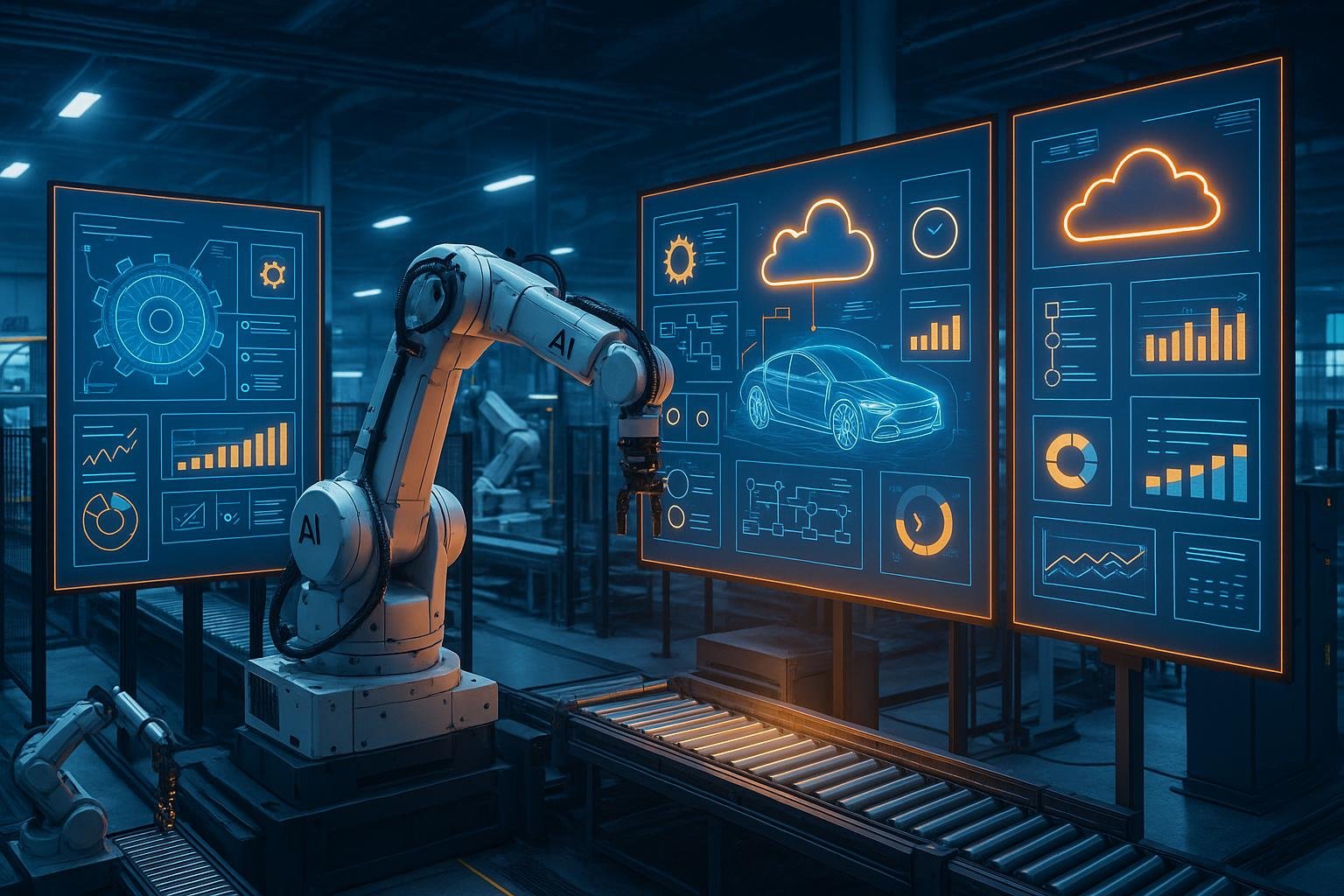
Integrating AI with cloud-native PLM systems is transforming manufacturing by enabling faster decision-making, improved product quality, and stronger security, says industry expert Ross Meyercord.

The promise of artificial intelligence is reshaping how manufacturers manage products from concept to customer. Ross Meyercord, chief executive of Propel Software, told BetaNews that combining AI with cloud-native product lifecycle management (PLM) can bridge long-standing div...
Continue Reading This Article
Enjoy this article as well as all of our content, including reports, news, tips and more.
By registering or signing into your SRM Today account, you agree to SRM Today's Terms of Use and consent to the processing of your personal information as described in our Privacy Policy.
Meyercord points to early, measurable returns. In a survey of 800 US employees across industrial equipment, medical devices, high tech and consumer goods, Propel found 65 percent of respondents are using AI in product operations; those already deploying AI reported gains including improved productivity (52 percent), competitive advantage (50 percent) and cost reductions or resource reallocation. He warned that firms delaying adoption risk ceding market position to more agile competitors.
The practical advantages of marrying AI and PLM are becoming familiar across industry reporting. AI-driven predictive maintenance and anomaly detection reduce unplanned downtime and extend asset life, while computer vision systems improve quality control by spotting defects earlier in production. Microsoft highlights how AI agents can relieve frontline staff of repetitive tasks and surface actionable insights so skilled workers concentrate on higher-value duties. Similarly, specialist advisers note that AI integrated into PLM supports smarter demand forecasting, reverse logistics and sustainability initiatives, helping manufacturers meet regulatory requirements and lower environmental impact.
Agentic AI, autonomous, continuously operating agents that monitor, anticipate and act, promises to amplify those gains when built on well-governed data. Meyercord likens such agents to an engineer “who never sleeps”, capable of flagging component issues ahead of recalls and automatically initiating change processes. He stresses, however, that capability rests on architecture and governance: agents need clearly defined roles, secure, role-based data access, measurable actions, and integrated controls so they act within compliance and business rules. Without those foundations, pilots often stall or produce limited benefit.
Platform choices matter. Cloud-native, single-platform PLM solutions can remove the security and integration frictions that proliferate when firms bolt AI tools onto fragmented systems. Manufacturing technology outlets report that embedding AI vision and analytics within PLM , as SAP and other vendors have been doing , creates a continuous feedback loop from the shopfloor to design, accelerating defect resolution, improving prototyping accuracy and shortening time-to-market. Industry analysis also finds that keeping AI within the systems that already enforce governance reduces vulnerability and simplifies auditability.
Real-world retail and product teams are already exploiting these dynamics. According to Axios, Walmart’s generative AI “Trend-to-Product” tool has compressed a seasonal fashion development cycle from roughly six months to about six weeks, demonstrating how rapid, AI-enabled iteration can reshape product timelines and responsiveness. That example underscores Meyercord’s point that when product and commercial teams share the same digital thread, businesses can move from slow handoffs to near-continuous collaboration.
Beyond speed and cost, AI-enabled PLM supports long-term product value. Thought pieces on PLM in the age of AI illustrate benefits across sectors, automotive, healthcare, consumer electronics, ranging from accelerated design cycles to personalised customer experiences and improved regulator compliance. Sustainability gains emerge where AI informs smarter reverse logistics and material choices, reducing waste across product lifecycles.
Security and trust must underpin scale. Meyercord recommends role-aligned access controls so that sensitive material remains protected even when queried through AI interfaces; firms should avoid ad hoc data transfers between tools that amplify attack surfaces. In practice, experts advise embedding AI within SaaS platforms where governance, encryption and audit trails are already enforced rather than assembling disparate point solutions.
For manufacturers seeking to translate AI’s potential into business outcomes, the prescription is architectural as much as technological: digitise and link product data, adopt platforms that maintain governance, define what autonomous agents are allowed to do, and measure the outcomes they drive. When those pieces come together, organisations can expect not only incremental efficiencies but the kind of cross-functional alignment that accelerates innovation, reduces risk and keeps products competitive throughout their lifecycle.
Source: Noah Wire Services
Subscribe to Industry Updates

