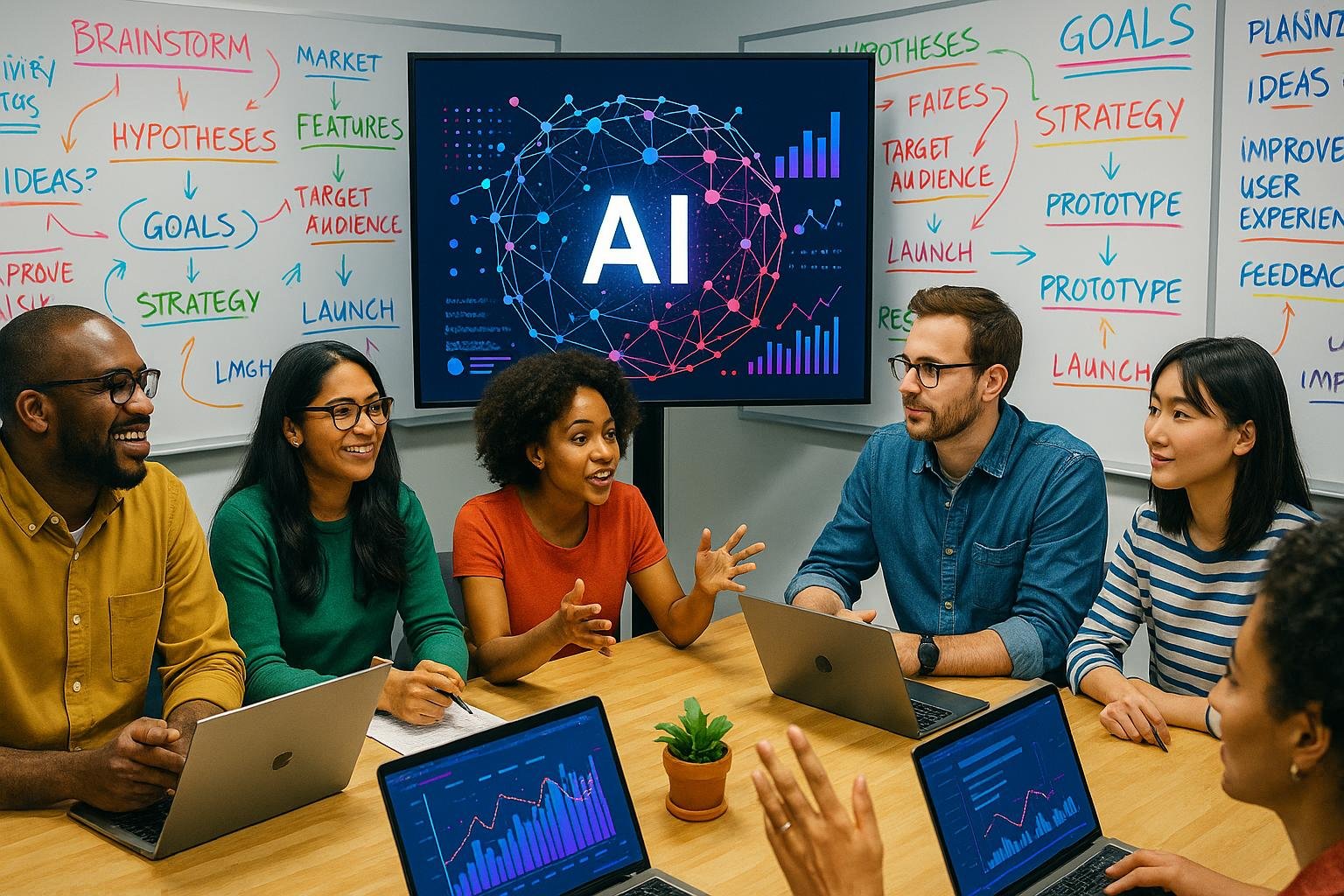
While AI can significantly cut innovation cycle times, organisations must integrate it into structured, hypothesis-driven processes to harness its full strategic potential and build lasting competitive advantage.

AI can dramatically shorten the time it takes organisations to discover and validate new opportunities, but only when it is woven into a rigorous innovation process. The promise of generative models as a shortcut to brainstorming or content production is real, ...
Continue Reading This Article
Enjoy this article as well as all of our content, including reports, news, tips and more.
By registering or signing into your SRM Today account, you agree to SRM Today's Terms of Use and consent to the processing of your personal information as described in our Privacy Policy.
At the front end of innovation, AI accelerates the mapping of assumptions about customers, behaviours and value. According to analysis from Innova365, automation can condense weeks of market and competitor assessment into minutes, enabling teams to expose gaps and edge cases far faster than traditional workshops allow. That expanded visibility widens the set of plausible solutions before human decision-makers choose a direction.
Once assumptions are clarified, AI expedites hypothesis generation and scenario framing. Research and reporting from venture and startup analysts show that generative systems can surface multiple framing angles and risk permutations quickly, helping teams explore a broader solution space without diverting scarce human attention from higher‑order decisions. Industry accounts describe this as converting individual effort into exponential output when paired with clear objectives.
AI also improves signal detection. Agentic and monitoring systems can scan customer conversations, patent filings, competitor moves and market signals continuously, spotting emergent patterns that conventional research cycles often miss. Forbes has reported examples where embedding AI across an innovation pipeline transformed planning cadences, an automaker reportedly shortened new vehicle planning from 18 months to four months, and university researchers compressed months of antibiotic discovery into a single week, illustrating how decision cycles, not just ideation, can be compressed when the technology is integrated end‑to‑end.
Crucially, AI supports validation but does not replace it. Customers and experiments still determine product–market fit. As the Lean Startup perspective notes, AI can design better experiments, simulate stress cases and refine test structures so teams learn more from each run. Procurement and operations reporting reinforces this point from the other side of the organisation: automating routine, data‑heavy tasks frees teams to focus on judgement and relationship work, as an IT director’s ability to provision dozens of laptops in minutes demonstrates.
Adoption at scale hinges on trust and measurable outcomes. CIO reporting shows a marked rise in practitioner confidence, roughly 62% of IT professionals say they trust AI more than a year ago, and links that trust to repeatable ROI and transparent governance. Absent that trust and clear metrics, speed can become deception; rapid outputs that lack verifiable signal risk producing false certainty and costly downstream scaling mistakes.
Organisations that will outpace peers are those that stop treating AI as a set of point tools and instead embed it within structured experimentation systems. According to broader industry commentary, AI’s impact multiplies when combined with modern infrastructure, edge computing, 5G and cloud ecosystems, and with leaders who prioritise disciplined hypothesis testing over tool fascination. Training for AI‑augmented innovation therefore should emphasise systems thinking and experiment design, not prompt engineering alone.
For innovation leaders the mandate is straightforward: build repeatable, measurable processes that use AI to broaden and accelerate learning while preserving human judgement as the arbiter of validation. Those who achieve that balance are likely to convert the technology’s speed into sustainable advantage rather than ephemeral novelty.
Source: Noah Wire Services
Subscribe to Industry Updates