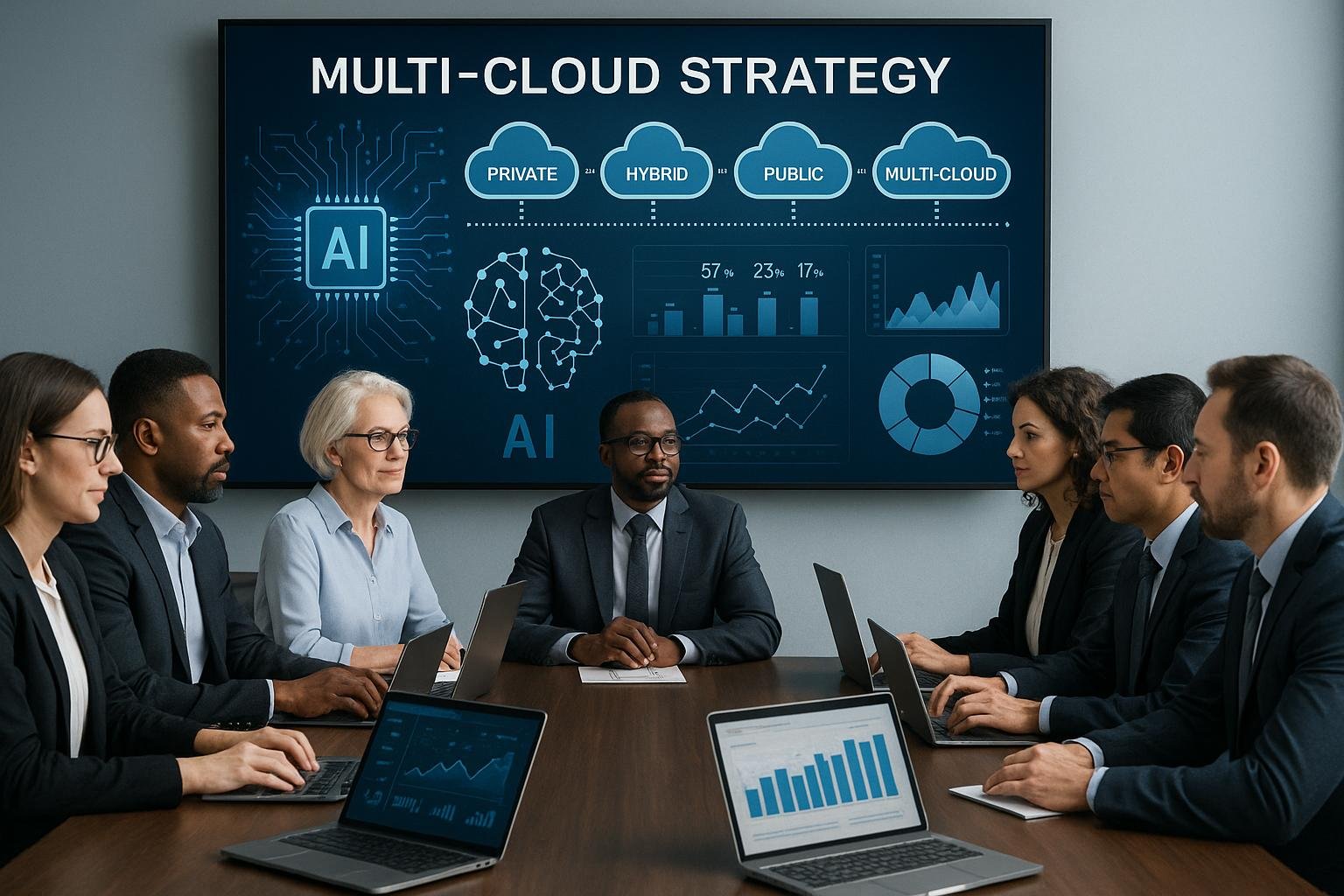
Accenture and Databricks have established a dedicated business group aimed at helping organisations transition from AI pilots to large-scale, enterprise-ready deployments, addressing industry-specific challenges and promoting multi-cloud strategies.

Accenture and Databricks have created a specialised business group to help organisations move beyond pilot projects and deploy large-scale artificial intelligence and agent-based systems on enterprise data platforms.
...
Continue Reading This Article
Enjoy this article as well as all of our content, including reports, news, tips and more.
By registering or signing into your SRM Today account, you agree to SRM Today's Terms of Use and consent to the processing of your personal information as described in our Privacy Policy.
The new group is backed by a workforce of more than 25,000 Databricks‑trained professionals who will deploy solutions tailored for enterprise AI workloads, including database infrastructure optimised for model training and inference, conversational interfaces that let staff query corporate data, and toolchains for building AI agents trained on internal datasets. Accenture highlighted existing customer use cases that pair its services with Databricks: Albertsons is using the platform to combine historical and predictive analytics for pricing, BASF has rolled out a digital assistant for finance and controlling, and Kyowa Kirin International is modernising its data estate to improve access to trusted information.
“By combining our deep mission expertise with Databricks’ Data Intelligence Platform, we’re helping critical agencies move from experimentation to production faster. Our work together on US Federal mission projects demonstrates how data-driven innovation can accelerate outcomes,” Accenture Federal Services said on a LinkedIn post.
The move fits into a broader pattern of Accenture forming dedicated alliances to industrialise AI. In December 2025 Accenture launched the Accenture Anthropic Business Group, with roughly 30,000 staff trained to work with Anthropic’s Claude models and a suite of offerings aimed at regulated industries, according to Accenture’s newsroom. At the same time, Accenture and Palantir created the Accenture Palantir Business Group to accelerate data-driven decision-making in government, energy and oil and gas, with forward‑deployed engineers and over 2,000 Palantir‑skilled Accenture professionals supporting deployments. Accenture’s expanded collaboration with Snowflake established an Accenture Snowflake Business Group to combine cloud, AI and data capabilities, backed by more than 5,000 SnowPro‑certified practitioners and a global Centre of Excellence. Earlier, Accenture’s partnership with NVIDIA formed an NVIDIA Business Group and an AI Refinery engineering network to support agentic architectures and foundation model development across tens of thousands of practitioners.
Those parallel efforts underscore a strategic approach: marry vertical and mission expertise with platform partners to shorten time to value and reduce the engineering lift required to operationalise models at scale. Industry observers say that combining deep implementation teams with platform tooling helps organisations confront common operational hurdles, data governance, lineage, reproducibility and cloud portability, while providing prebuilt patterns for productionising models and agents.
Databricks, for its part, has been attracting a range of services partners seeking to accelerate customers’ AI journeys. In June 2025 Kyndryl announced a global strategic alliance with Databricks to help clients modernise IT estates and adopt the Databricks platform for scalable analytics and AI, signalling growing demand for partner ecosystems that deliver both platform expertise and systems‑integration services.
For clients, the promise of these business groups is pragmatic: reduce friction in creating an “AI‑ready” data estate, embed governance and security, and enable business functions to extract operational value from models and agents. Accenture’s description of the Databricks group emphasises practical outcomes, migrating data, standing up AI‑optimised infrastructure and building conversational and agentic experiences tuned to internal datasets, rather than purely experimental work.
Yet the strategy also raises questions for organisations about vendor concentration and interoperability. Industry executives note that while tightly coupled partnerships can speed delivery, they require careful attention to long‑term portability, contractual terms around models and data, and the balance between customised solutions and standardised architectures.
Accenture and Databricks will be positioning the new business group to meet that balance: provide accelerators and skilled practitioners to shorten deployment timelines while supporting multi‑cloud architectures and industry‑specific needs. If the group achieves the scale claimed by its backers, it will join a roster of Accenture platform alliances designed to move enterprises from experimentation into sustained, governed AI operations.
Source: Noah Wire Services
Subscribe to Industry Updates